quick answer
Choose Firefly 20PRO if most of your flying is short, fast, and aggressive. It is the better match for 4S freestyle, punch-outs, tight gaps, quick direction changes, and pilots who like a micro drone that reacts.
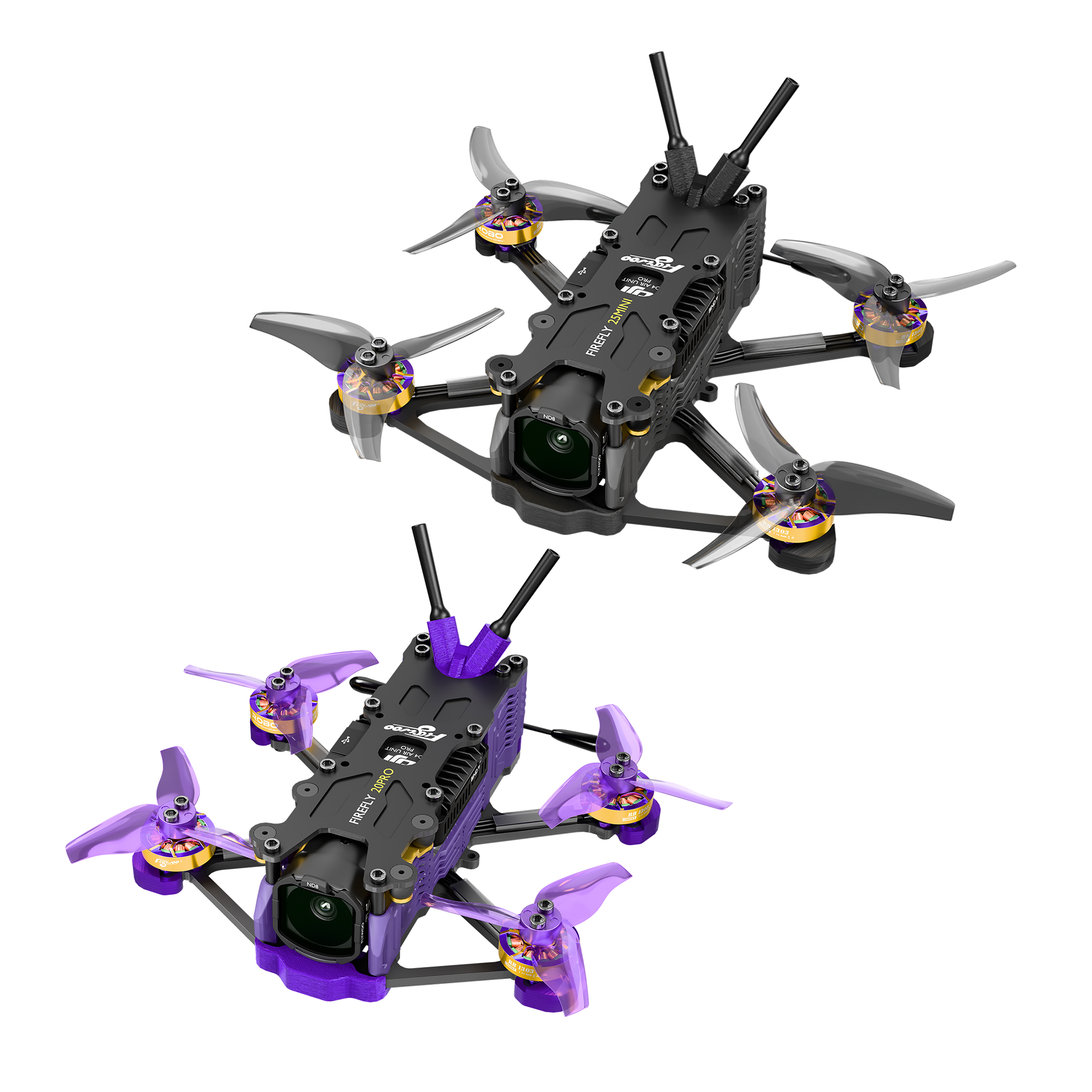
Official Firefly 20PRO vs 25MINI guide for 4S freestyle, 3S endurance, O4 Pro vs O4 Wide, batteries, BNF options, and frame swap checks.
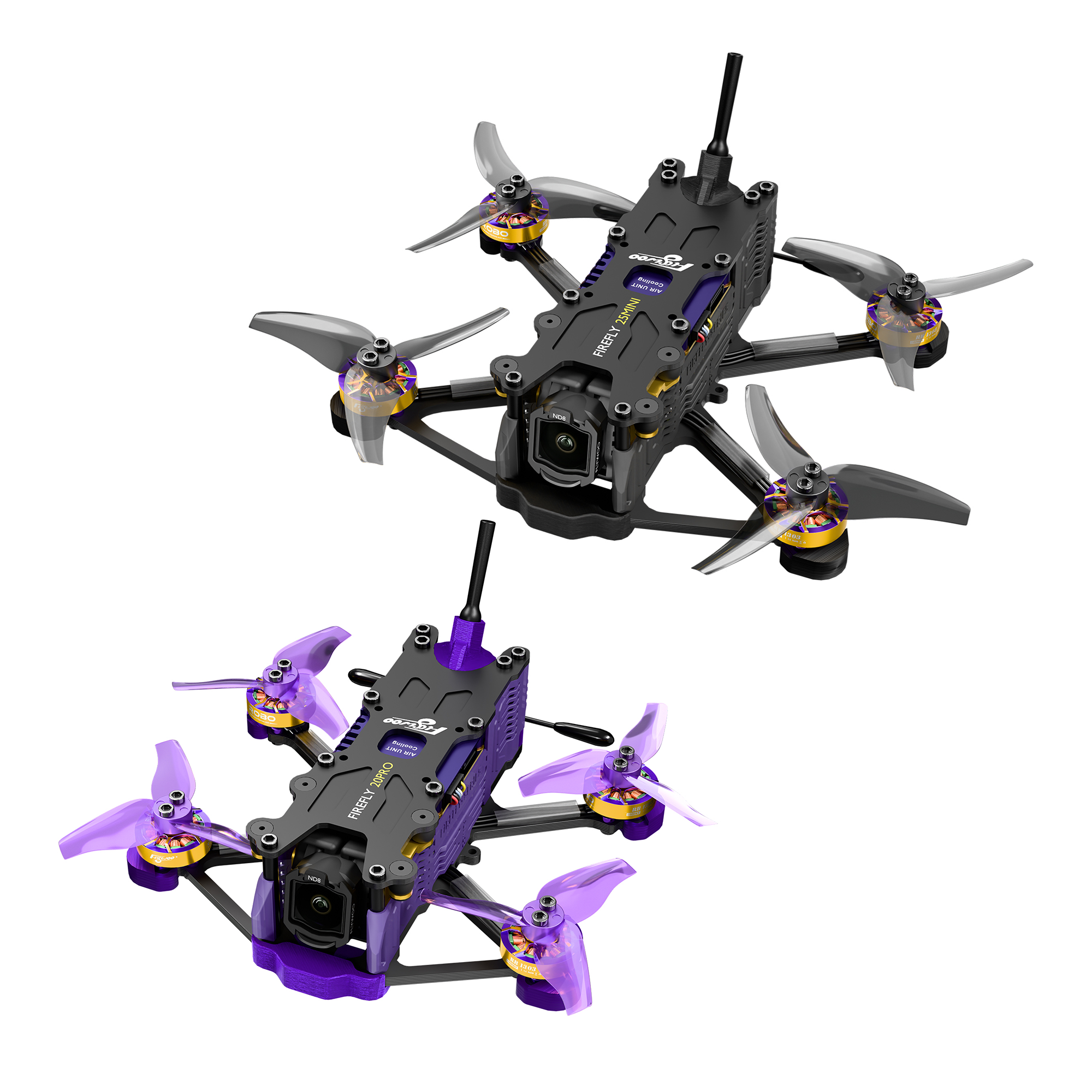
We built Firefly 20PRO and Firefly 25MINI for pilots who keep asking the same question in different words: "Should I buy the fast one or the one that flies longer?" The honest answer is that neither frame is the universal winner. Firefly 20PRO is the 2-inch 4S setup for sharper freestyle, quicker recovery, and a harder top end. Firefly 25MINI is the 2.5-inch 3S setup for smoother lines, longer packs, and more relaxed outdoor flying. Both share the same.
Choose Firefly 20PRO if most of your flying is short, fast, and aggressive. It is the better match for 4S freestyle, punch-outs, tight gaps, quick direction changes, and pilots who like a micro drone that reacts.
A single micro frame can be tuned to do many things, but it always leans somewhere. If we make it small and sharp enough for fast 4S freestyle, it gives up some efficiency. If we stretch it for 2.5-inch props and longer.
Spec sheets can get noisy, so start with the numbers that change how the drone flies. Spec point Firefly 20PRO O4 Pro Firefly 25MINI O4 Pro ------------ ---------------------- ------------------------ Prop 2023-3 2-inch.
A useful comparison explains when each option wins. The right model depends on where it flies, what it records, what goggles it uses, and how often it needs repairs.
The winner is the one that fits the mission with the fewest compromises, not the one with the loudest spec line.
Battery cell count is not a badge. It changes the shape of the flight. On Firefly 20PRO, 4S gives the drone a sharper upper half of the throttle. That matters when you miss a line.
Pick Firefly 20PRO if these sound like you: 1. You fly short freestyle packs and do not mind landing after five or six minutes. 2. You want stronger recovery after dives, split-S.
The frame choice is only half of the decision. The video version changes the weight, cost, and camera priority. The Firefly 20PRO / 25MINI O4 Pro version is the image-first setup..
We built Firefly 20PRO and Firefly 25MINI for pilots who keep asking the same question in different words: "Should I buy the fast one or the one that flies longer?"
The honest answer is that neither frame is the universal winner. Firefly 20PRO is the 2-inch 4S setup for sharper freestyle, quicker recovery, and a harder top end. Firefly 25MINI is the 2.5-inch 3S setup for smoother lines, longer packs, and more relaxed outdoor flying. Both share the same modular idea: the expensive digital video system can live on one upper assembly while the lower frame decides the flight style.
This guide is written from our side of the bench. We are not trying to rank one model above the other. We are explaining why we made both, where each one feels right, and what you should check before ordering.
Choose Firefly 20PRO if most of your flying is short, fast, and aggressive. It is the better match for 4S freestyle, punch-outs, tight gaps, quick direction changes, and pilots who like a micro drone that reacts immediately.
Choose Firefly 25MINI if you care more about time in the goggles. The 2.5-inch prop and 3S battery setup make it better for cruising, practice packs, smoother camera movement, and pilots who want the drone to feel calmer without becoming boring.
If you already know you want both styles, the modular Firefly system is the reason these two frames exist together. You can treat 20PRO as the fast lower frame and 25MINI as the endurance lower frame, then decide how much you want to invest in the video system on top.
A single micro frame can be tuned to do many things, but it always leans somewhere. If we make it small and sharp enough for fast 4S freestyle, it gives up some efficiency. If we stretch it for 2.5-inch props and longer flights, it becomes less snappy in tight freestyle.
So we split the job.
| Question | Firefly 20PRO | Firefly 25MINI |
|---|---|---|
| What size is it built around? | 2-inch props | 2.5-inch props |
| What battery style fits the stock personality? | 4S LiHV | 3S LiHV |
| What does it feel like? | Quick, punchy, direct | Smoother, more efficient, more settled |
| Who should start here? | Pilots who want freestyle and speed | Pilots who want longer park sessions and cleaner lines |
| What is the trade-off? | Shorter flight time | Less top speed |
That is the real Firefly 20PRO vs 25MINI decision. It is not about which airframe is newer or more expensive. It is about whether you want the battery to feel like a throttle weapon or a flight-time tool.
Spec sheets can get noisy, so start with the numbers that change how the drone flies.
| Spec point | Firefly 20PRO O4 Pro | Firefly 25MINI O4 Pro |
|---|---|---|
| Prop | 2023-3 2-inch tri-blade | 2520-3 2.5-inch tri-blade |
| Listed weight without battery | About 113 g | About 113.5 g |
| Battery class | 4S LiHV 550 mAh or 750 mAh | 3S LiHV 450 mAh, 750 mAh, or 1000 mAh |
| Hover throttle | About 22 to 24 percent | About 25 to 27 percent |
| Flight time in our O4 Pro data | About 5 minutes on 450 mAh, about 6 minutes 30 seconds on 750 mAh | About 8 minutes on 550 mAh, about 9 minutes 30 seconds on 750 mAh, about 12 minutes 30 seconds on 1000 mAh |
| Max speed in our O4 Pro data | Up to 120 km/h | Up to 95 km/h |
The part that surprises people is hover throttle. Firefly 20PRO hovers lower, but Firefly 25MINI flies longer. That is not a contradiction.
Lower hover throttle means the 20PRO has more throttle headroom. It can recover harder and accelerate faster. Flight time is a different problem. The 25MINI uses a larger prop and a 3S setup that suits efficient cruising better, so it can stay in the air longer when you fly it the way it is meant to be flown.
If you remember one thing from the table, make it this: 20PRO is about headroom. 25MINI is about minutes.
Battery cell count is not a badge. It changes the shape of the flight.
On Firefly 20PRO, 4S gives the drone a sharper upper half of the throttle. That matters when you miss a line and need to climb out quickly, or when you want the quad to snap through a gap instead of floating toward it. A 2-inch 4S micro does not need much space to feel fast.
On Firefly 25MINI, 3S works with the larger prop instead of fighting it. The drone carries speed more smoothly. It is easier to draw a line through a park, follow a subject, or keep a shot stable without making tiny throttle corrections every second.
This is why we do not tell every new pilot to buy the "more powerful" one. Power is useful only when it matches the flying site. In a tight backyard, a fast 4S micro can feel nervous. In a wide open bando, the 25MINI can feel too polite. The right choice depends on where you fly most weekends.
Pick Firefly 20PRO if these sound like you:
Pick Firefly 25MINI if these sound closer:
There is also a third buyer: the pilot who wants both lower frames because the expensive part is the O4 system. That pilot should think of the 20PRO and 25MINI as two tools, not two competing purchases.
The frame choice is only half of the decision. The video version changes the weight, cost, and camera priority.
The Firefly 20PRO / 25MINI O4 Pro version is the image-first setup. Choose it when onboard image quality matters, when you want the stronger DJI camera pipeline, and when you are willing to accept the extra weight and cost on a small airframe.
The Firefly 20PRO / 25MINI O4 Wide version is the lighter DJI O4 path. Choose it when you want the same Firefly frame logic with lower weight, a wide FPV view, and a lower price than O4 Pro.
| Video path | Best for | Watch out for |
|---|---|---|
| O4 Pro | Image quality, onboard recording, pilots who want the strongest camera option | More weight, more value on the top plate, more attention needed around camera mounting |
| O4 Wide | Lighter DJI O4 micro builds, lower cost, wide FPV view | Less image headroom than O4 Pro |
| Drone kit without VTX | Builders who already own compatible video hardware | More setup work and more responsibility for fitment |
If you are mostly choosing between 20PRO and 25MINI for flying feel, O4 Wide makes that difference easier to feel because the build is lighter. If you are choosing because footage matters most, O4 Pro is the reason to accept the extra grams.
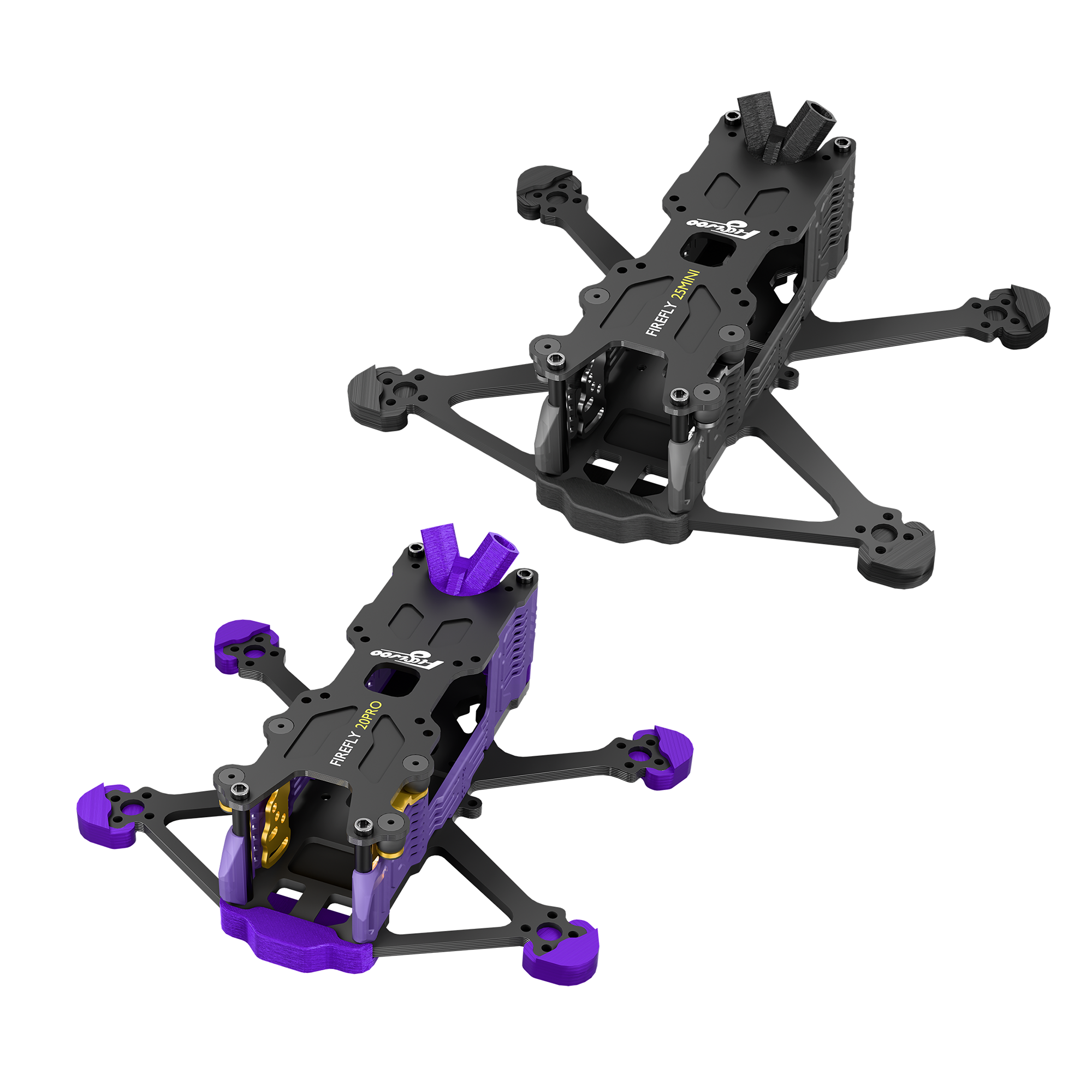
The modular design is simple, but it is still aircraft hardware. Treat the upper assembly as a setup you want to repeat exactly.
Before you swap between 20PRO and 25MINI, check these points:
For pilots who crash often, this matters more than it sounds. A clean frame swap saves money only if the video system goes back into the same position every time. If the camera angle, damping pressure, or antenna route changes on every swap, the drone will feel inconsistent.
For rebuilds, lower frames, props, GPS mounts, TPU, and spare plates, use the Firefly 20PRO / 25MINI frame kit and parts page. That page is the practical repair path for this family.
This is where many first-time DJI micro buyers make a wrong assumption. BNF means bind-and-fly. It does not mean ready-to-fly.
The standard drone package includes the aircraft, spare props, tool, anti-slip pads, ND filter, right-angle USB-C data cable, battery straps, side panels, shock absorber parts, nylon nuts, washers, and screw kit.
It does not mean the box includes everything you need for the first flight.
Before checkout, confirm:
If you are new to this class, budget for batteries and a charger at the same time as the drone. A micro drone with one pack is a short afternoon.
For 20PRO, we like the build as a compact 4S freestyle micro. Start with the 550 mAh pack if you want the lightest feel. Use 750 mAh when you want a little more time without changing the character too much. Keep the prop choice close to the stock setup before you start chasing tune changes.
For 25MINI, start with 750 mAh if you want a balanced daily setup. Move to 1000 mAh when you care about longer cruising and do not mind the extra battery weight. The larger prop gives the 25MINI room to carry that pack better than the 20PRO would.
For O4 Pro, spend more time checking the camera mount and damping. For O4 Wide, pay attention to weight and battery placement because the lighter build makes balance changes easier to notice.
For both frames, do the boring first pack:
That pack tells you more than another hour of reading.
The first mistake is buying 20PRO for endurance. It can cruise, but that is not its strongest reason to exist.
The second mistake is buying 25MINI and expecting it to feel like a 4S ripper. It is not slow, but its best trait is how long and smooth it feels for its size.
The third mistake is treating O4 Pro as automatically better for every pilot. O4 Pro gives you more image headroom, but the lighter O4 Wide setup can be the better flying drone for some pilots.
The fourth mistake is assuming the drone includes batteries, goggles, radio, charger, and GPS. Check the box contents. Then check them again.
No. Firefly 20PRO is better for 4S freestyle and faster flying. Firefly 25MINI is better for 3S endurance and smoother cruising. If you fly short aggressive packs, start with 20PRO. If you want longer outdoor sessions, start with 25MINI.
Yes, but treat it as an advanced setup. The normal 25MINI personality is 3S endurance. If you run 4S, use the recommended Betaflight limits and watch motor temperature. If your main goal is 4S freestyle, the 20PRO is the cleaner stock choice.
Yes. Running 3S on the 20PRO reduces power and can make the drone feel calmer. It does not turn the 20PRO into a 25MINI. The 20PRO still has the smaller 2-inch prop and the tighter frame.
Most new outdoor micro pilots should start with 25MINI. More flight time gives you more practice per pack, and the throttle feel is easier to manage. A beginner who already flies simulator, owns 4S packs, and wants freestyle can still choose 20PRO.
Choose O4 Pro if footage quality is the priority and you accept the extra weight. Choose O4 Wide if you want a lighter DJI O4 micro with a wide FPV view and lower cost. The frame decision is about flight style. The video decision is about image quality, weight, and budget.
Not necessarily. The modular Firefly setup lets the video system sit on the upper assembly while the lower frame defines the flight style. If you want both 20PRO and 25MINI personalities, the system is designed around that idea.
No. The standard package does not include flight batteries, charger, DJI goggles, radio controller, or GPS. Choose the receiver version that matches your radio, then add the right batteries and charger separately.
If you are still choosing the whole micro FPV category, start with our micro FPV drone buying framework. If you already know you want a DJI O4 Firefly micro, use this guide to choose the lower frame: 20PRO for 4S freestyle, 25MINI for 3S endurance.
Use the article body, product links, and spec tables to pick the product path that matches the flight job. Keep the choice practical: frame size, video system, battery, cooling, and repair path all matter more than a generic ranking.
These product cards are generated from the exact SHOPLINE products linked in the article, so the title, image, and button always point to the same product record.
Jul 23,2026 | FLYWOO